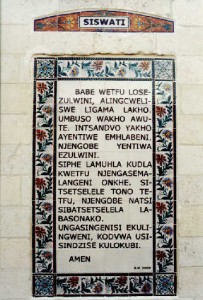
siSwati Prayer
[UPDATED: 21 June 2013]
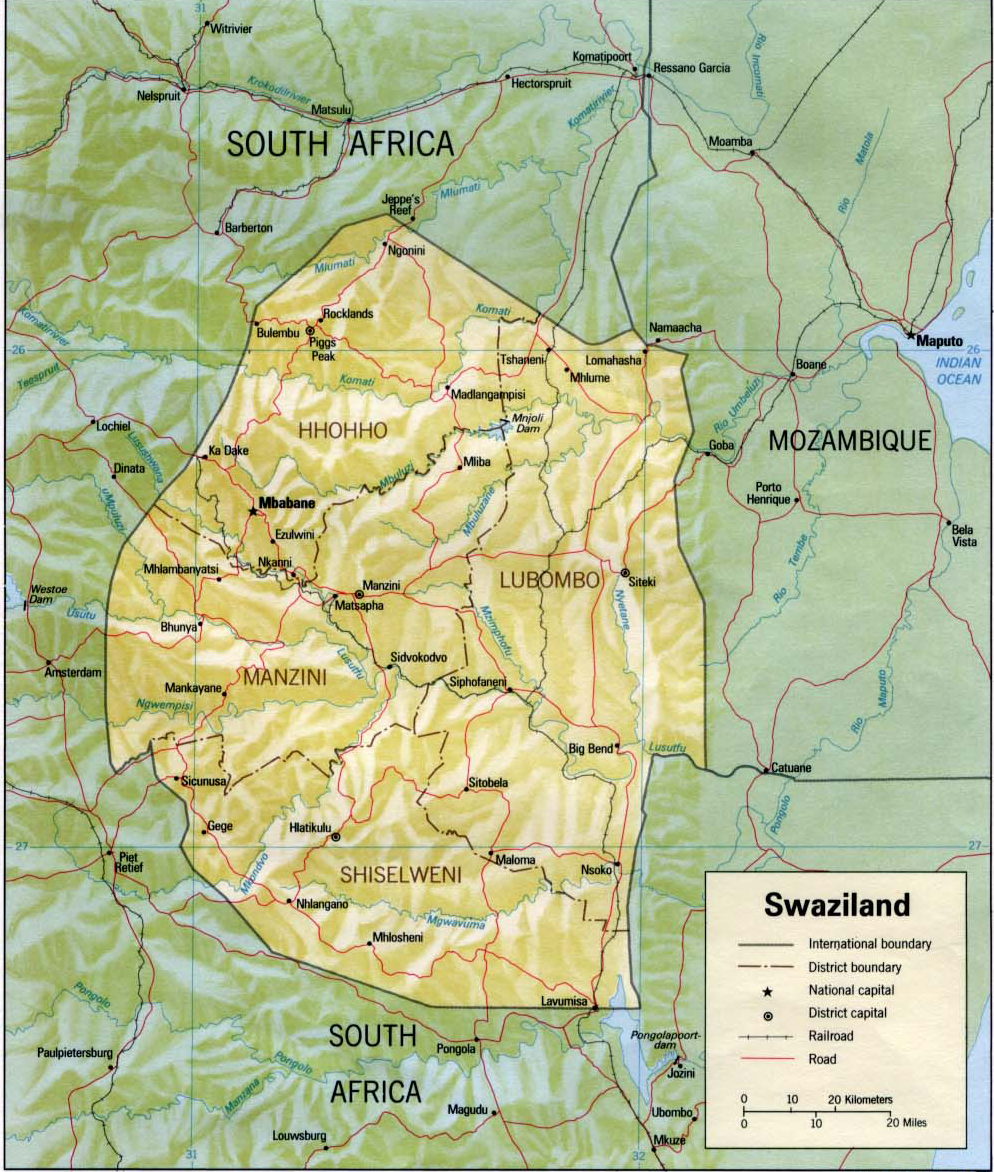
SiSwati is one of two official languages in the Kingdom of Swaziland (English being the other). It is a Bantu language and of the Nguni sub-group. It shares significant similarities to Zulu, and native speakers find the languages mutually intelligible.
Swaziland uses English in business and governmental settings, but siSwati is considered the native tongue. For perspective, if you are in a meeting in Swaziland people will usually speak English, but when you go lunch the discussion will usually be in siSwati.
In our own quest to learn siSwati we have found that since only one million people speak it as a first language (3 Million overall), it has been a bit difficult to find helpful resources. It is hard enough (impossible) to find a local speaker in the US, let alone a teacher or lessons. Thus, I have tried to pull together a list of online and print resources. I hope this list is helpful for other people who may be in a similar situation trying to learn siSwati.
Peace Corp Material:
By far the most current and widely available material comes from the Peace Corp. They provide a pre-departure pack that includes a study manual and accompanying MP3s. It is far from comprehensive, but it does a great job of getting you used to the language and introducing you to basic phrases. You won’t be able to communicate with just this material, but you will be able to be polite. Here are the links to the pre-departure materials:
The above material is the most current, but it is not the most comprehensive. You may also benefit from their older publications.
- siSwati Language Handbook – Download from ERIC, Published 1980, 116 pages. This is primarily a collection of narratives in English and siSwati. Helpful for an intermediate learner, but the language is a bit dated.
- Understanding and Speaking siSwati – Download from ERIC, Published 1969, 449 pages. This is comprehensive manual, but unfortunately it is quite dated as many of the language conventions and phrases have changed.
The Peace Corp has also just released a new manual for its Swaziland Volunteers and it is very nice. It is a great mix of useful information, important phrases and essential grammar. It is the best resource I have found that pulls together what you need to begin learning siSwati. Unfortunately it has not been publicly released, although if you send me an email, I will try to point you in the right direction. If Peace Corp puts it out for general use, I will certainly link to it here.
Print Materials:
Unfortunately, I have not been able to come across a single print resource that effectively pulls together everything you need to learn the language (especially if you are trying to teach yourself.) However, I have found the books listed below, when used together, provide a great base to build on. I have provided links to the Amazon and Google Books pages so you can get the details on the books (ISBN, book cover, etc.)
- Handbook of siSwati – Published 1991, 175 pages. This is a course book for classes at UNISA and thus takes a more academic approach. This is where you are going to learn about grammatical structure and parsing. (Amazon | Google)
- Essential siSwati – Published 1981, revised 1990, 80 pages. This is a basic phrasebook designed to be a quick reference. It also includes stem charts. It is a great companion to understand how actual siSwati phrases are formed. I have found some of the phrases are a bit dated. (Amazon | Google)
- Concise siSwati Dictionary – Published 1981, 187 pages. Neither of the above books do a good job of teaching vocabulary, so you really need a dictionary. Just know that because of the way siSwati works, you have to have a basic understanding of the language before you can even use this. It too is an older resource and some of the words are “Deep siSwati” instead of daily use. (Amazon | Google)
- Silulu SesiSwati – Published 2010, 452 pages. This new dictionary was recently published as part of a large African Languages collaboration. It boasts to have been the first dictionary compiled by native speakers. It provides English > siSwati as well as siSwati > English translations, but is a better resource for those looking to learn English. Much more up to date than the above dictionary, but is missing key works, and doesn’t do a great job of explaining the differences in various translations (i.e. which are transitive and intransitive forms). However, if I was only getting one dictionary, I would choose this one for sure. It is often referred to as “The Red Dictionary” (as opposed to the Blue one above) for its plain red design. (Google)
I have seen all of these books in Swaziland (Websters in Manzini has had all three, CNA in Mbabane and Manzini usually have least couple of them). We were also able to find them online, but we had to search around for them. Besides Amazon (US), here are a couple other places you can look:
Memorization:
Of course to learn siSwati (or any language) you first need to memorize vocab and prefixes/suffixes. I have tried many different options in the past, but recently discovered Anki. It is an easy-to-use flashcard program that works on computers and mobile devices. If you use your computer or Android, it is free (iTunes charges a small fee). It uses algorithms to focus your study time on new and difficult words while stilling keeping the words you know in your memory. You can find out more on the Anki Website.
The best way to learn is to create the “deck” of anki cards yourself, but if you want to go with a short cut, I have upload an excel sheet of 550 siSwati words and phrases from my anki deck. It took me about two months to learn these at 30 minutes per day.
Everyone is going to learn their own way, but I found it helpful to prioritize these words into 3-4 groups based on importance and frequency (and upload in appropriate batches). Then I focused on seeing the siSwati and knowing the English. As I got used to these words, I also included the English word and had to know the siSwati translation. (This is easily accomplished by simply typing selecting the “Show Reverse” option on appropriate cards.)
It took me about two months to learn these by using Anki 30 minutes per day. That base allows me to pick up key words in conversation and also have the most basic of conversations (assuming you know some grammar rules to accompany it).
Grammar Notes:
Knowing vocabulary is useless if you can’t put it together into meaningful sentences (or be able to parse sentences given to you.) Learning the grammar is way outside the scope of this post, but I can tell you that to have a basic understanding of siSwati, you have to understand noun prefixes, verbal extensions, morphemes, subject concords and object concords. If that already makes sense to you (or you are willing to learn from the books listed above), then this siSwati Cheat Sheet might be helpful.
Other Resources:
Another resource to look into once you begin getting a basic understanding is YouTube. There are several videos posted in siSwati (mostly religious) which will be helpful in practicing comprehension. This one is particularly helpful because it includes English subtitles: Thandiwe
I had the opportunity to talk with a headmaster at a school in Swaziland. I asked him which resources he would recommend and here is what he had to say:
The best book (if you can obtain it) is from the Sebenta National Institute called ‘siSwati Setfu’ translated ‘Our siSwati’ and was a joint venture publication between the Sebenta National Institute and the US Government, under contract no. 79-042-100.
I have not been able to track it down, but if you do, please let me know where.
—
Hopefully the above resources will be helpful if you are one of the very few who want to teach yourself siSwati. I will continue to update this post as I find more.